If you’ve ever taken a basic computer science class in India — or cracked open a Class 9 textbook — you’ve probably seen this claim: “The abacus is the first computer.”
That statement shows up in textbook after textbook, usually accompanied by a picture of a Chinese suanpan and a paragraph about how the abacus was the ancestor of modern computers. And then you move on to Charles Babbage and the Analytical Engine.
But the connection between the abacus and computers is actually more interesting (and more nuanced) than textbooks make it sound. Let me break it down properly.
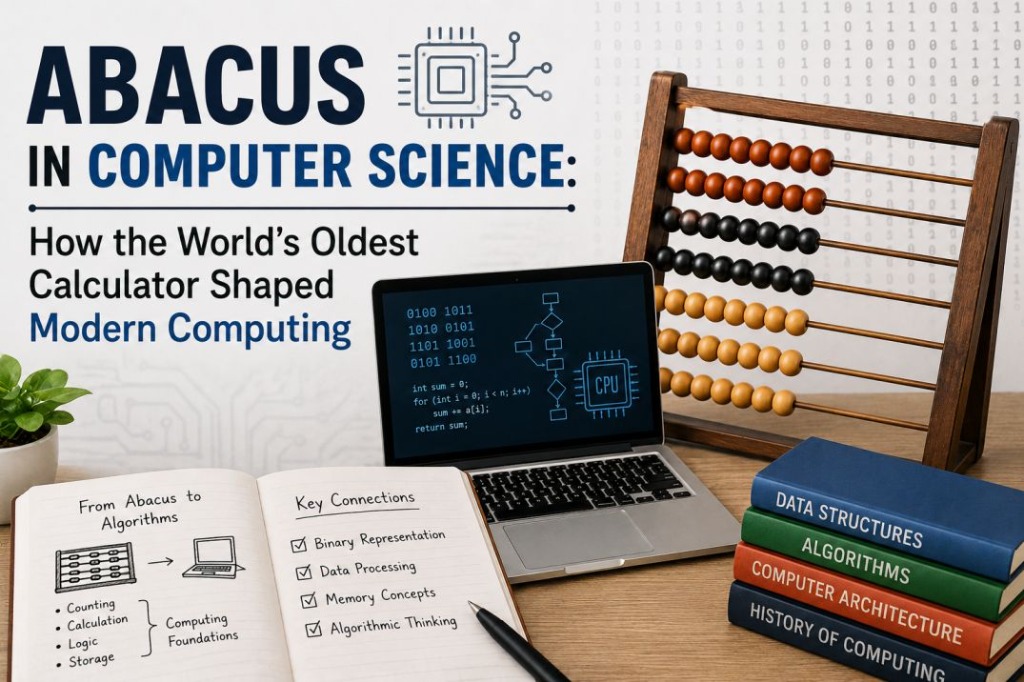
Is the Abacus Actually a Computer?
Strictly speaking, no. And here’s why.
A computer — by the modern definition — is a machine that can be programmed to carry out a sequence of operations automatically. The key word is automatically. You give it instructions (a program), and it executes them without human intervention at each step.
The abacus doesn’t do this. It doesn’t execute instructions on its own. YOU move the beads. YOU decide which operation to perform. YOU carry out each step manually. The abacus is a tool that helps you calculate, but it doesn’t calculate independently.
So in the strict technical sense, the abacus is a calculating aid or calculating tool, not a computer. The same way a ruler is a measuring tool but not a measurement machine.
That said, calling the abacus the “first computer” isn’t entirely wrong if you use the older definition of the word. Before electronic machines, “computer” literally meant “a person who computes” — someone who does calculations. And the abacus was the first widely-used tool that made human computation faster. So it was the first tool for computers (the people), even if it wasn’t a computer (the machine) itself.
The Conceptual Bridge
Where the abacus genuinely does connect to modern computing is in the concept it demonstrates. The abacus proved something important:
Numbers can be represented physically, and mathematical operations can be carried out through systematic physical manipulations.
That idea — representing abstract numbers as physical states, and performing math by changing those states according to rules — is the exact same principle that drives every computer ever built.
On an abacus:
- Physical state = position of beads on rods
- Rules = complement methods, carrying rules
- Operation = moving beads according to those rules
On a modern computer:
- Physical state = voltage levels in transistors (high = 1, low = 0)
- Rules = logic gates (AND, OR, NOT operations)
- Operation = electrical signals flowing through circuits according to those rules
Same concept. Different medium. The abacus uses wood and beads. The CPU uses silicon and electrons. But the underlying idea — “represent numbers physically and manipulate them systematically” — is identical.
The Timeline: From Abacus to CPU
Here’s how calculating tools evolved, roughly:
1. The Abacus (~2700 BCE – present)
Manual bead manipulation. No automation, but it proved that physical representations of numbers work. Used continuously for over 4,000 years.
2. Napier’s Bones (1617)
Scottish mathematician John Napier created a set of numbered rods that simplified multiplication and division. Still manual, but more specialized than the abacus.
3. Pascal’s Calculator – Pascaline (1642)
Blaise Pascal built a mechanical calculator with gears and wheels. This was the first machine that could add and subtract with some automation — you turned the dials, and the gears handled the carrying. Important because it automated a specific part of the calculation process.
4. Leibniz’s Stepped Drum (1694)
Gottfried Wilhelm Leibniz extended Pascal’s design to handle multiplication and division. He also conceived of the binary number system, which would become crucial to computing centuries later.
5. Babbage’s Difference Engine (1822) and Analytical Engine (1837)
Charles Babbage designed machines that could follow a sequence of instructions. The Analytical Engine included concepts like memory (“store”), a processing unit (“mill”), and the ability to loop and branch — essentially the blueprint for modern computers. Ada Lovelace wrote the first algorithm for this machine, earning her the title of the first programmer.
6. Punched Card Machines – Hollerith (1890)
Herman Hollerith used punched cards to process the US Census data. This led to the founding of a company that eventually became IBM.
7. Electronic Computers – ENIAC (1945)
The first fully electronic, general-purpose computer. 17,468 vacuum tubes. Weighed 30 tons. Could do 5,000 additions per second. The abacus does about 1-2 per second in trained hands.
8. Transistors and Integrated Circuits (1947 – 1960s)
Transistors replaced vacuum tubes. Then multiple transistors were packed onto a single chip (integrated circuits). This miniaturization eventually led to modern CPUs with billions of transistors.
9. Modern CPUs (present)
A modern Intel or AMD processor has around 10-20 billion transistors, each one essentially a switch that can be on or off (1 or 0). It performs billions of operations per second. The concept is the same as the abacus — physical states representing numbers, manipulated by rules — just scaled up by a factor of approximately a billion.
What Is “Abacus” in Computer Textbooks?
In Indian school curricula (CBSE, ICSE, and state boards), the abacus appears in Class 3-5 computer science as an introductory concept. The typical textbook presentation:
“The abacus was the first calculating device, invented in China around 3000 BCE. It consists of beads on rods and was used for arithmetic.”
Then they jump to Pascal’s calculator and Babbage’s engine. The abacus serves as the “origin story” — it’s the first step in a narrative that leads to modern computers.
This is fine as a simplified introduction. But if you want a more accurate picture, the abacus wasn’t the first step in a single chain of invention. It was more like a parallel development — abacuses were evolving in Asia while mechanical calculators were being developed in Europe, and electronic computers were a separate leap that drew on both traditions.
The “Full Form” Question
This comes up constantly in Indian exams: “What is the full form of ABACUS in computer?”
The commonly cited answer is:
Abundant Beads Adding Calculating Utility System
I want to be very clear: this is not a real acronym. The word “abacus” comes from the Greek word abax (flat surface/board), which possibly derives from the Hebrew ābāq (dust). It’s been a word for thousands of years. Nobody sat down and created a backronym for it.
But the backronym exists in textbooks and exam papers, so if you need it for a test, there it is. Just know that it was invented after the fact, not the other way around.
The Binary Connection
There’s one more thread worth pulling. Leibniz, the same mathematician who built the stepped drum calculator in 1694, also formalized the binary number system — representing all numbers using just 0s and 1s.
He was inspired by the Chinese I Ching (an ancient divination text that uses broken and unbroken lines — essentially binary). There’s a beautiful historical irony here: Chinese culture produced both the suanpan (a decimal calculating tool) and the I Ching (which inspired the binary system that would power all modern computers).
The abacus itself is a decimal tool — it works in base 10. But the conceptual leap from “physical states representing numbers” (abacus) to “two states representing numbers” (binary) to “voltage levels representing numbers” (electronic computers) is a remarkably clean line of evolution.
Abacus AI — A Modern Connection?
If you’ve searched for “abacus AI,” you might have found a company rather than a historical connection. Abacus.AI is a modern machine learning platform that helps businesses build and deploy AI models. It was founded in 2019 by Bindu Reddy.
The name is presumably a nod to the idea that just as the abacus was the foundational tool for calculation, their platform aims to be a foundational tool for AI. But there’s no technical connection between the traditional abacus and artificial intelligence.
There are, however, some interesting research papers on using neural networks to model mental abacus calculations — essentially training AI to mimic how human mental abacus users process numbers. This research is more about understanding human cognition than about building better AI, but it’s a cool intersection.
So, Should You Call the Abacus the “First Computer”?
For an exam? Yes. That’s the expected answer.
For accuracy? Call it the first widely-used calculating tool. It demonstrated the principle that physical devices could represent and manipulate numbers — a principle that eventually evolved into modern computing through a long chain of inventions over 4,000+ years.
The abacus didn’t directly cause the invention of the computer any more than the wheel directly caused the invention of the car. But it was an essential conceptual ancestor, and without the idea it proved, the path to electronic computing would have looked very different.
Want to Use the Original “Computer”?
If all this history has made you curious, the fastest way to understand the abacus is to actually use one. We built a free online abacus that works exactly like a traditional soroban. No installs, no signup — just open it and start clicking beads.
It’s satisfying to use a calculating tool that’s been around for 4,000 years and still works perfectly. Especially when your phone battery dies and you can do mental math because you practiced on an abacus.
For the step-by-step on how to actually use it, check our beginner’s guide.
Written by Devdatta Dhaigude
Creator of AbacusTool.xyz. B.Tech Computer Engineering. 500+ students taught abacus and mental arithmetic.
More about the author →