If you’ve decided to learn abacus — or your kid has started classes — the next question is usually: “Do I need to buy an abacus kit? Which one? And how much should I spend?”
The short answer: you need an abacus, but you don’t need to spend a lot. And depending on your situation, you might not need a physical one at all.
Let me walk you through the options.
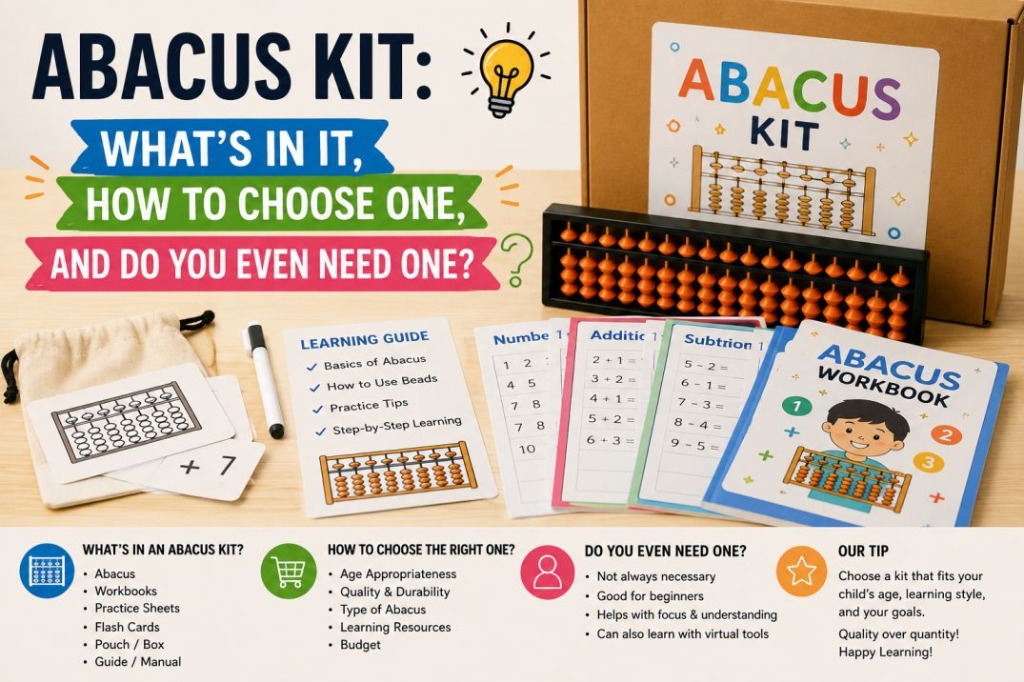
What Comes in a Typical Abacus Kit?
Most “abacus kits” sold on Amazon, Flipkart, or at stationery shops include:
The basics:
- 1 abacus (usually a 13-rod or 17-rod soroban)
- 1 workbook (beginner-level problems)
- Sometimes a carrying pouch
The premium kits add:
- Multiple workbooks for different levels
- A smaller “student abacus” (7-rod) for speed training
- Flash cards with number representations
- A practice book for mental abacus
- A certificate or level chart
Price ranges (India):
| Kit Type | Price Range | What You Get |
|---|---|---|
| Basic (just the abacus) | ₹150-300 | A functional soroban. Nothing else. |
| Standard kit | ₹400-800 | Abacus + 1-2 workbooks + pouch |
| Premium kit | ₹1,000-2,000 | Abacus + multiple workbooks + student abacus + flash cards |
| Classroom set (10 units) | ₹2,500-4,000 | 10 basic abacuses + teacher guide |
My honest recommendation: start with the basic ₹200-400 standalone abacus. You don’t need the workbooks — free alternatives exist online (including our worksheet generator). And you definitely don’t need a ₹2,000 premium kit when you’re just trying it out.
How to Choose a Good Abacus
Not all abacuses are created equal. Here’s what to look for:
Rod count: 13 or 17 rods?
13-rod abacus: The standard for home practice. 13 rods means you can represent numbers up to the trillions, which is way more than anyone needs for learning. This is what most programs (SIP, UCMAS, etc.) use for daily practice.
17-rod abacus: Larger. Used in some competition settings. Unless your child is specifically training for competitions that require a 17-rod, go with 13. It’s more portable and less intimidating.
7-rod student abacus: A small, portable version. Used in later stages of training when students are transitioning to mental abacus. Not a starter tool — it’s too small for beginners who need to see the full rod layout clearly.
Bead quality matters more than you think
Cheap abacuses have beads that:
- Stick and don’t slide smoothly
- Are all the same color (harder for beginners to differentiate rows)
- Are made of rough plastic that catches on the rod
A decent abacus has:
- Smooth-sliding beads that move freely with a gentle push
- Distinct colors for the heaven bead vs. earth beads (or alternating row colors)
- A firm reset mechanism — when you tilt the abacus flat, all beads should settle into the “zero” position cleanly
The difference between a ₹150 abacus and a ₹350 abacus is usually the bead quality. The extra ₹200 is worth it. The difference between ₹350 and ₹1,500 is usually the brand name. Not worth it.
Frame material
Plastic frame: Most common. Light, cheap, durable. Fine for learning. This is what 90% of students use.
Wooden frame: Feels nicer. Slightly heavier (which some people prefer — it sits on the table more stably). Costs 2-3x more than plastic. Not necessary, but if you appreciate the aesthetics, go for it.
Metal frame: Rare and expensive. Some competition-grade abacuses use aluminum frames. Overkill for learning.
Bead size
Standard size (~15-18mm diameter): Good for ages 6 and up. Most widely available.
Large size (~20-22mm): Better for very young children (4-5) with smaller fingers who are still developing fine motor skills. Also good for elderly users.
Small/compact size (~10-12mm): For experienced users who want portability. Not suitable for beginners.
Where to Buy
Online (India)
- Amazon.in — Widest selection. Sort by ratings. Look for “Soroban” or “Japanese abacus” specifically.
- Flipkart — Similar selection. Sometimes cheaper than Amazon for the same product.
- IndiaMart — Bulk orders and classroom sets. Good for teachers.
Offline
- Local stationery shops — Many carry basic abacuses, especially near schools. Usually ₹150-300.
- Educational toy stores — Places like Hamleys, FirstCry, or local equivalents. Tend to be overpriced for the same product.
- Abacus class centers — SIP, UCMAS, etc. sell their own branded kits. These are decent quality but marked up because they’re “official.”
What to avoid
- Abacuses marketed as “toys” with very bright colors and chunky beads. These are designed for toddler play, not actual calculation. The beads are usually too large and don’t have the correct 1/4 (soroban) layout.
- Anything that says “100-bead abacus” — that’s a counting frame, not a soroban/suanpan. It’s a different tool with a different purpose.
Do You Even Need a Physical Abacus?
Honestly? For the first 1-3 months of learning, a digital abacus works just fine.
We built our free online abacus to behave exactly like a physical soroban:
- Beads click and slide
- It supports both Soroban (1/4) and Suanpan (2/5) modes
- It shows the current value so you can verify your work instantly
- It works on phones, tablets, and desktops
- No signup, no ads
Advantages of digital first:
- Free (obvious)
- Instant feedback — the value display tells you immediately if you set the wrong number
- Available everywhere — practice on your phone during a commute
- No beads to lose (if you’ve ever had a toddler grab an abacus, you know)
When you should get a physical one:
- When you’re past the basics and want to build finger technique for speed
- When your abacus class requires a physical tool for homework
- When you’re transitioning to mental abacus (some people find the tactile feedback helps with visualization)
- When your child simply prefers the physical experience (some kids do)
A reasonable path: Start with our free digital tool. Learn the basics. If you stick with it past week 3, buy a ₹300 physical abacus. If you’re still going after 3 months, maybe invest in a nicer one with smooth beads.
How to Make an Abacus at Home (DIY)
This is a surprisingly fun weekend project, especially with kids. Here’s what you need:
Materials
- A shoebox or small cardboard box (the frame)
- 5-7 wooden dowels or bamboo skewers (the rods)
- Beads — you can use pony beads, wooden beads from a craft store, or even large pasta tubes (rigatoni works)
- A strip of cardboard (the dividing bar)
- Hot glue or tape
Steps
- Cut the box: Use a shallow box. Cut the top off so it’s open.
- Poke holes: On two opposite sides of the box, poke 5-7 evenly-spaced holes (one for each rod).
- Add the dividing bar: Glue a horizontal strip of cardboard about 1/3 from the top, spanning the width of the box. This creates the “heaven” and “earth” sections.
- Thread the rods: Push dowels through the holes on both sides.
- Add beads: Before pushing each rod through the second side, thread beads onto it — 1 bead in the heaven section and 4 beads in the earth section for soroban style.
- Secure the rods: Glue or tape the ends so they don’t slide out.
The result won’t be as smooth as a store-bought abacus, but kids get a kick out of making it themselves. And building it helps them understand the structure — which rod is ones, which is tens, and so on.
Improving the DIY version
If you want better bead movement:
- Use smooth wooden or glass beads instead of plastic pony beads
- Sand the dowels lightly so beads slide more easily
- Use a wooden frame (a small picture frame works) instead of cardboard
Quick Reference: Abacus Bead Layout
For anyone who needs a visual reference:
Soroban (Japanese) Layout
Heaven:  ○         ← 1 bead (value: 5)
         ─────────  ← dividing bar
Earth:   ○         ← each bead (value: 1)
         ○
         ○
         ○         ← 4 beads total
Suanpan (Chinese) Layout
Heaven:  ○         ← 2 beads (value: 5 each)
         ○
         ─────────  ← dividing bar
Earth:   ○         ← each bead (value: 1)
         ○
         ○
         ○
         ○         ← 5 beads total
The Bottom Line
An abacus is one of the cheapest educational tools you can buy. ₹200-400 gets you a perfectly functional one. You don’t need a premium kit, a branded product, or expensive accessories.
Start free with our digital abacus. If you want a physical one later, buy the cheapest decent-quality soroban you can find. Spend your budget on consistent practice time, not on hardware — the ₹300 abacus will teach you exactly the same math as the ₹2,000 one.
And if you’re feeling crafty, making one from scratch is a great way to spend a Sunday afternoon with your kids. It won’t win any design awards, but it’ll work — and they’ll understand the tool better for having built it themselves.
Written by Devdatta Dhaigude
Creator of AbacusTool.xyz. B.Tech Computer Engineering. 500+ students taught abacus and mental arithmetic.
More about the author →