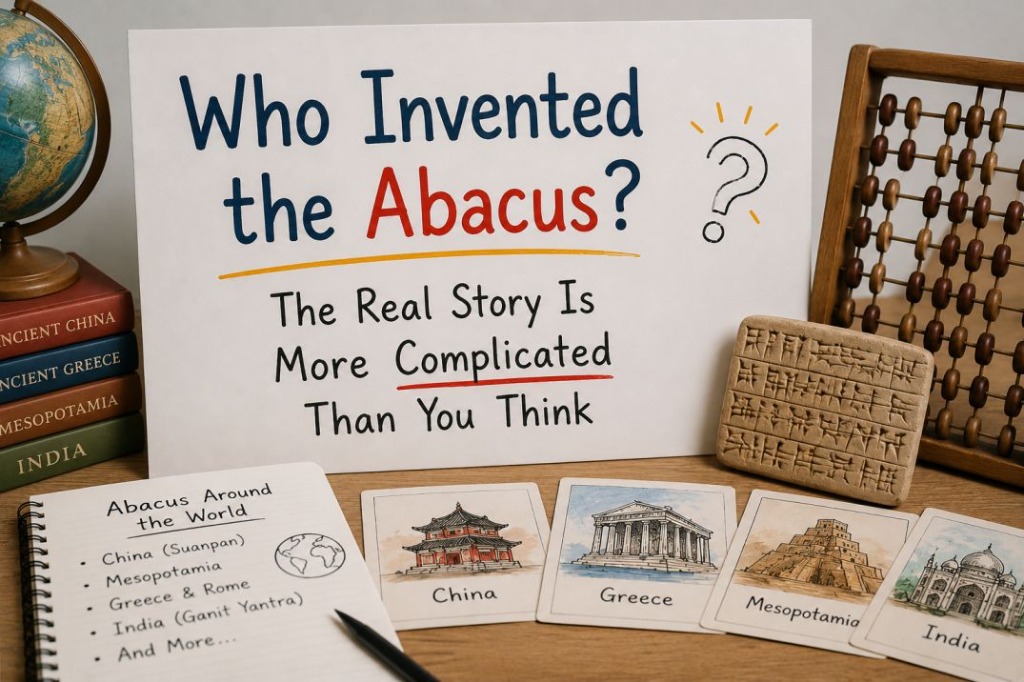
If you Google “who invented the abacus,” you’ll get a neat little answer box saying something like “the ancient Chinese” or sometimes “the Mesopotamians.” Both answers are kind of right. Neither tells the full story.
The truth is, nobody invented the abacus the way Alexander Graham Bell invented the telephone. There wasn’t one person in one place who had a eureka moment. The abacus — or at least the concept of using a physical tool to count — popped up independently in several civilizations over several thousand years.
Here’s how it actually played out.
The Earliest Counting Devices (3000–2000 BCE)
Before the abacus as we know it, people needed to count things. Livestock, grain, debts. And your fingers only get you to 10.
The first counting tools were incredibly simple: pebbles arranged in rows, or lines drawn in sand or dust. The Sumerians in Mesopotamia (modern-day Iraq) were using clay tablets with columns for counting as early as 2700 BCE. These weren’t abacuses in the wooden-frame sense, but the concept was identical — physical markers representing numbers, organized by place value.
These early counting boards worked. A merchant could lay out pebbles in the ones column, tens column, hundreds column, and track transactions that would be impossible to do in your head. Some historians consider this the true “invention” of the abacus concept, even though it looked nothing like what we picture today.
The Greek Counting Board (~500–300 BCE)
The ancient Greeks had their own version, and we actually have physical proof.
The Salamis Tablet is a white marble slab measuring about 150 × 75 cm, discovered on the island of Salamis near Athens. It dates to roughly 300 BCE and it’s now sitting in the Epigraphical Museum in Athens. It has lines and Greek letters carved into it that served as guides for placing pebbles during calculations.
The Greeks called their counting pebbles psephoi, and the board itself was called an abax — which is where we get the word “abacus.” The original meaning of abax was simply “flat surface” or “table.” Some scholars think it came from the Hebrew word ābāq, meaning “dust,” because early counting boards were literally dusty surfaces where you’d draw lines with your finger.
The Greek method was columnar, similar to what the Mesopotamians used. Each column represented a different power of 10. Place a pebble in the right column, and you’ve got your number.
Interestingly, the word “calculate” comes from the Latin calculus, which means “small stone.” Those little pebbles on counting boards literally gave us the word for doing math.
The Roman Abacus (27 BCE – 500 CE)
The Romans took the Greek idea and made it portable.
The Roman hand abacus was a metal plate (usually bronze) with grooves cut into it. Instead of loose pebbles, it used small beads that slid along the grooves. This was a significant upgrade — no more pebbles rolling off the table.
A few of these have survived. The most famous one is in the Bibliothèque nationale de France in Paris. It has seven long grooves and seven short grooves, with beads that slide up and down. Sound familiar? That’s because the basic design — a top section and a bottom section, with the top beads worth more — is essentially the same as the Chinese suanpan that appeared centuries later.
Whether the Romans and Chinese developed these independently or whether ideas traveled along the Silk Road is still debated. Most historians lean toward independent invention, since the timeline doesn’t quite line up for direct influence. But it’s hard to know for sure.
China’s Suanpan (200 CE – Present)
This is where the abacus really became The Abacus.
The suanpan (算盘) first appears in Chinese literature around 200 CE. The mathematician Xu Yue described a bead-on-rod counting device in his work Supplementary Notes on the Art of Figures. But there are arguments that simpler versions existed earlier — some historians point to evidence from the Han Dynasty (206 BCE – 220 CE).
The classic suanpan design has:
- A rectangular wooden frame
- Rods running vertically (or horizontally, depending on the era)
- A dividing bar separating “heaven” beads from “earth” beads
- 2 heaven beads on top (each worth 5)
- 5 earth beads on the bottom (each worth 1)
This 2/5 layout means each rod can represent values from 0 to 15. That’s more than you need for base-10 math, but the extra capacity made certain operations easier, particularly in traditional Chinese measurement systems that used base-16 (for weighing, where 1 jin = 16 liang).
The suanpan became central to Chinese commerce, government, and education. For nearly 2,000 years, it was the primary calculating tool across East Asia. Merchants used it for accounting. Government officials used it for taxation. Students learned it in school.
In 2013, UNESCO added the Chinese abacus to the Representative List of the Intangible Cultural Heritage of Humanity. That’s how significant it is.
Japan’s Soroban (1600s – Present)
The Chinese suanpan traveled to Japan via Korea sometime in the late 1500s to early 1600s. Initially, the Japanese used it in its original 2/5 bead form.
But over the next few centuries, Japanese mathematicians started streamlining the design:
- First, they dropped one of the top beads (going from 2/5 to 1/5) around the early 1800s.
- Then they dropped one of the bottom beads (going from 1/5 to 1/4) in the early 1900s.
- By 1938, the Japanese Abacus Committee officially standardized the 1/4 design we see today.
The reasoning was practical: the extra beads on the suanpan weren’t needed for base-10 arithmetic, and they actually slowed down expert users. Fewer beads meant less visual clutter and faster finger movements.
The result — the soroban (そろばん) — is objectively the most efficient abacus design for decimal arithmetic. One heaven bead (worth 5) and four earth beads (worth 1 each) per rod. Each rod represents exactly the digits 0–9. Nothing extra.
Japan took abacus education seriously. The soroban was a required subject in Japanese elementary schools through most of the 20th century. Even today, millions of Japanese students take the annual proficiency exams administered by the Japan Chamber of Commerce. The highest rank, 10th dan, requires calculating speeds that would make most people’s heads spin.
The Abacus in India
Now, here’s a question that comes up a lot in Indian exam papers: “Who invented the abacus in India?”
The honest answer: nobody invented the abacus in India. India didn’t develop its own independent abacus tradition the way China, Japan, or Greece did. But India’s relationship with the abacus is still significant, just in a different way.
India’s great contribution to mathematics was the decimal number system itself — the Hindu-Arabic numeral system (0, 1, 2, 3… 9) that the entire world uses today. This system, developed by Indian mathematicians like Aryabhata (5th century CE) and Brahmagupta (7th century CE), is what makes the abacus work so intuitively. Each rod = one digit. That’s the Indian number system in physical form.
In modern India, the abacus arrived primarily through Japanese and Chinese educational programs. Organizations like UCMAS (Universal Concept of Mental Arithmetic System), SIP Abacus, and Aloha brought structured abacus training to India starting in the 1990s and 2000s. Today, India is one of the largest markets for abacus education in the world.
So India didn’t invent the abacus, but Indian mathematics made the abacus possible in its current form, and Indian students are now some of the most prolific abacus learners globally. That’s a pretty interesting full circle.
The Russian Schoty
Worth mentioning: Russia had its own abacus called the schoty (счёты), widely used from the 17th century right through the Soviet era. It looks different from the Asian versions — it has 10 beads per wire arranged horizontally, with the middle two beads colored differently to help with quick counting.
Russian shopkeepers were still using the schoty well into the 1990s. You might still find one in some shops today.
Why Did So Many Civilizations Independently Invent the Same Thing?
This is the part that I find genuinely fascinating.
The Mesopotamians, Greeks, Romans, Chinese, Japanese, and Russians all came up with essentially the same idea: use physical objects organized in columns to represent numbers and perform arithmetic.
That’s not a coincidence. It’s because the abacus solves a fundamental problem — humans need to count beyond what their fingers and memory can handle. And the most intuitive solution is the same everywhere: create a physical model of the number system, then manipulate it.
The specific implementations differed (pebbles vs. beads, sand vs. grooves, 2/5 vs. 1/4), but the underlying concept is universal. That’s probably why the abacus has survived for over 4,000 years while countless other tools have been forgotten.
So Who Gets the Credit?
If a test asks “Who invented the abacus?” the safest answers are:
- The Mesopotamians (earliest known counting boards, ~2700 BCE)
- The Chinese (developed the suanpan, the ancestor of modern abacuses, ~200 CE)
If the question is more specific:
| Question | Answer |
|---|---|
| Who invented the first counting board? | Mesopotamians, ~2700 BCE |
| Who invented the bead-on-rod abacus? | Chinese (suanpan), ~200 CE |
| Who invented the modern abacus design? | Japanese (soroban), standardized 1938 |
| Who invented the abacus in India? | The abacus wasn’t invented in India; it was imported via Chinese/Japanese educational programs in the 1990s |
The real answer is that the abacus is a human invention — one that appeared independently wherever people needed to count. And that’s a better answer than pinning it on any single person or culture.
Want to Try One?
You don’t need to find a physical abacus. We built a free digital abacus that works exactly like a real soroban. It supports both the Japanese (1/4) and Chinese (2/5) styles. No signup, works on any device.
If you want to understand the history by actually using the tool, that’s the fastest way to get it. Move some beads around, and you’ll immediately see why this design has lasted for millennia.
Check out our beginner’s guide to get started, or jump straight into practice.
Written by Devdatta Dhaigude
Creator of AbacusTool.xyz. B.Tech Computer Engineering. 500+ students taught abacus and mental arithmetic.
More about the author →