You’ve probably seen one sitting on a shelf in a classroom somewhere — a wooden frame with colored beads on rods. Maybe your kid’s school sent home a flyer about abacus classes. Or you stumbled across an online abacus tool and thought, “People still use these?”
Yeah. They do. And there’s a pretty good reason for that.
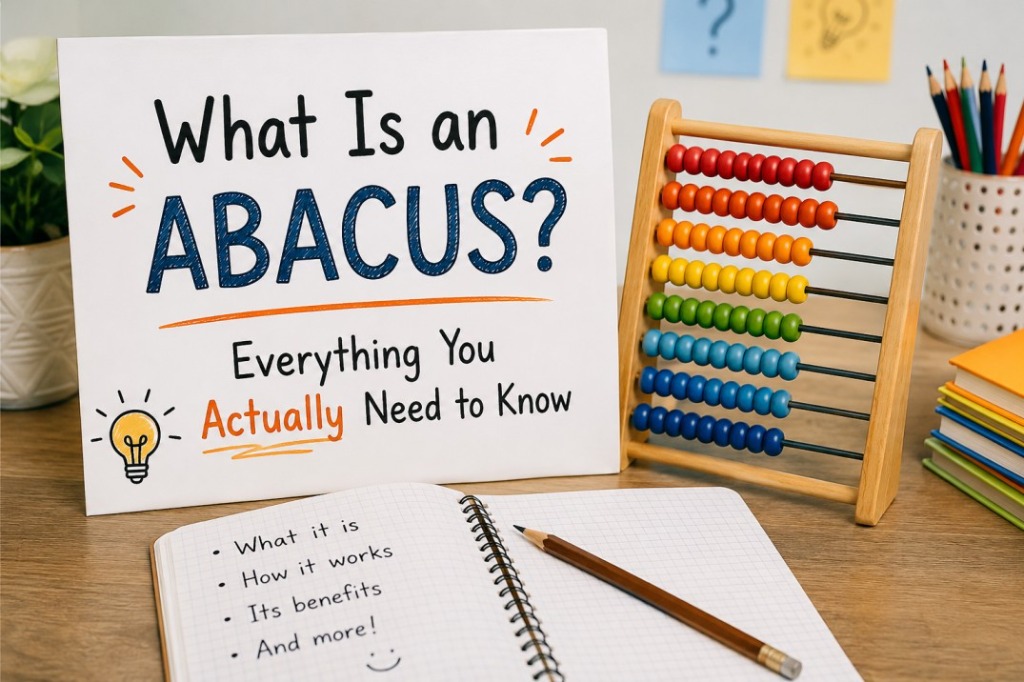
What Is an Abacus, Exactly?
An abacus is a counting tool. That’s the simple answer. It’s a frame with rods running through it, and beads that slide back and forth. You move the beads to represent numbers, and then you can add, subtract, multiply, and even divide using specific bead movements.
It’s basically a calculator that runs on finger power instead of batteries.
The word “abacus” comes from the Greek word abax, which meant a flat surface or a board covered in sand where you’d draw calculations. The Latin picked it up, and here we are.
There’s a backronym floating around online — ABACUS standing for “Abundant Beads Adding Calculating Utility System.” It’s not a real historical full form. Someone made it up. But it shows up on exam papers sometimes, so now you know.
The Two Main Types You’ll Run Into
If you start looking into abacuses (or abaci, if you’re feeling fancy), you’ll quickly realize there are two big ones that matter today:
Soroban — The Japanese Abacus
This is the one most people learn on now. It has:
- 1 bead on top (called the heaven bead, worth 5)
- 4 beads on the bottom (called earth beads, each worth 1)
Each rod represents a place value — ones, tens, hundreds, and so on. So one rod can show any digit from 0 to 9.
The design is clean and efficient. Japan standardized it in the 1930s by removing extra beads from the older Chinese version. Less beads, less confusion, faster calculations.
Suanpan — The Chinese Abacus
The original. It’s been around since roughly 200 CE (some historians argue earlier). It has:
- 2 beads on top (each worth 5)
- 5 beads on the bottom (each worth 1)
This means each rod can technically represent up to 15, which gives you more flexibility for certain calculations. It’s bulkier than the soroban, but some practitioners prefer it for that extra range.
Both work perfectly fine for learning. If you’re just starting out, the soroban is probably easier because there are fewer beads to keep track of.
What Is an Abacus Used For?
Here’s where it gets interesting. The abacus isn’t just a relic from a museum. People actively use it for several things:
Mental math training. This is the big one. When you practice on an abacus long enough, your brain starts to build an internal picture of the beads. Researchers call this a “mental abacus.” You can eventually do the calculations in your head without touching a physical tool. Some trained users can add five-digit numbers faster than someone punching them into a calculator.
Teaching kids about numbers. Abstract math is hard for a 6-year-old. But sliding colorful beads on a rod? That clicks. The abacus makes place value, carrying, and borrowing physical and visible. A lot of Indian schools — both SIP Abacus and UCMAS programs — use it extensively for this reason.
Brain exercise for adults. This one’s gaining traction. Learning the abacus as an adult is a genuine cognitive workout. It works your memory, your concentration, and your number sense all at the same time. Some people treat it like sudoku, except the skills actually transfer to real-life math.
Speed competitions. Yes, there are abacus competitions. The All Japan Soroban Championship is a real thing. Participants add columns of 15-digit numbers in seconds. It’s genuinely impressive to watch.
What Does Abacus Mean in Maths?
In a mathematics context, the abacus is a calculating device that demonstrates the base-10 number system through physical manipulation.
That’s the textbook answer. Here’s what it actually means in practice:
Each column on the abacus represents a power of 10. The rightmost column is ones (10⁰), next is tens (10¹), then hundreds (10²), and so on. When you push beads toward the center bar, you’re “activating” them — adding their value to the total.
So if you push up 3 earth beads on the ones rod and 1 heaven bead plus 2 earth beads on the tens rod, you’ve got 73. That’s it.
The math operations work by following rules for when to carry over (when a column exceeds 9, you reset it and add 1 to the next column) and when to borrow (the reverse). These are the same rules you learned for paper arithmetic, just expressed through bead movements instead of pencil marks.
The nice thing is, once you internalize these rules on the abacus, the concepts stick. Kids who learn addition on an abacus tend to understand why carrying works, not just that they’re supposed to do it.
The Abacus and Computers — What’s the Connection?
Here’s something that comes up a lot, especially in Indian school syllabi: “What is abacus in computer?”
The abacus is often cited as the earliest ancestor of the modern computer. And that’s… sort of true, with some caveats.
The connection is conceptual, not mechanical. The abacus introduced the idea that you could represent numbers physically and manipulate them using a defined set of rules. That’s exactly what a computer’s arithmetic logic unit (ALU) does — just with electrical signals instead of wooden beads.
Charles Babbage, who designed the Analytical Engine in the 1830s (widely considered the first general-purpose computer concept), was certainly aware of the abacus. But he was building on centuries of mechanical calculators that came after it — Pascal’s calculator, Leibniz’s stepped drum, and so on.
So the abacus didn’t directly lead to the computer the way a prototype leads to a product. It’s more like… the abacus proved that mechanical calculation was possible, and that idea eventually evolved through many generations of machines into what we have today.
The “Full Form” in Computer Science
You might also see “ABACUS full form in computer” on various exam prep sites. The commonly listed one is:
Abundant Beads Adding Calculating Utility System
Again — this isn’t an official acronym. The word “abacus” predates computers by several thousand years. It’s from Greek/Latin. But if it’s on your exam, now you have the answer.
There’s also “Abacus AI” — that’s a modern tech company, not related to the traditional tool. They do machine learning infrastructure. Different thing entirely.
How Old Is the Abacus?
Old. Really old.
The earliest counting devices we know about are clay tablets from Mesopotamia, dating to around 2700–2300 BCE. These weren’t exactly abacuses in the modern sense — they were more like counting boards with grooves for pebbles.
The Chinese suanpan appears in written records around 200 CE, though some historians believe it was in use earlier. The mathematician Xu Yue wrote about it in his work Supplementary Notes on the Art of Figures.
The Japanese soroban arrived via Korea in the late 1500s, originally as a copy of the Chinese version. Over the next few centuries, Japanese mathematicians gradually simplified it, dropping the extra beads until it reached the 1/4 design we use today (standardized around 1930).
There’s also the Salamis Tablet — a marble counting board from ancient Greece, dating to about 300 BCE. It’s sitting in a museum in Athens right now. And the Roman abacus, which used grooves and pebbles (the Latin word calculus literally means “small stone” — that’s where we get the word “calculate” from).
The point is, every major civilization independently came up with some version of this idea. When that happens, you know the concept is fundamentally sound.
Is an Abacus Still Worth Learning?
Here’s our honest take: yes, but it depends on what you want out of it.
If you’re a parent looking to give your kid a math advantage: The research is solid. Stigler’s 1986 study and several followups showed that abacus-trained children develop stronger number sense and calculate faster. Programs like UCMAS and SIP Abacus are popular in India for this reason. You don’t need to enroll in expensive classes, though — a free online abacus tool and some consistent practice at home can get you surprisingly far.
If you’re an adult wanting to sharpen your mental math: It works. The learning curve is steeper because adults tend to overthink the bead movements, but once it clicks (usually after 2-3 weeks of daily practice), you’ll notice yourself calculating faster in everyday situations.
If you’re studying for a school exam: You just need to know what it is, the basic structure, and the historical context. This article covers all of that.
If you’re looking for a fun brain exercise: Honestly, it’s more engaging than most “brain training” apps. There’s something satisfying about the physical (or digital) click of beads that a Sudoku puzzle doesn’t have.
Getting Started
If you want to try it out, you don’t need to buy anything. We built a free abacus tool that works exactly like a real soroban — you click (or tap) the beads, and it tracks your calculations. It runs on any device, no signup needed.
We also have a step-by-step guide that walks you through the basics in about 10 minutes, and a structured learning path if you want to get serious about it.
The abacus has been around for thousands of years because it works. It’s not flashy, it’s not high-tech, and it doesn’t need a WiFi connection. Sometimes the simplest tools are the ones that last.
Written by Devdatta Dhaigude
Creator of AbacusTool.xyz. B.Tech Computer Engineering. 500+ students taught abacus and mental arithmetic.
More about the author →