Your neighbor’s kid just won some mental math competition. Or maybe you saw an ad on Instagram for “abacus classes — enroll now!” Whatever brought you here, you’re trying to figure out: are abacus classes actually worth it, and how do you find a good one near you?
I’ve been through this process — both as someone who teaches abacus and as someone who’s evaluated dozens of programs. Here’s what I wish someone had told me from the start.
The Big Programs You’ll See Everywhere
In India (where the majority of abacus class searches come from), there are a few major players. They’re all franchised, meaning the quality can vary a lot from one center to another.
SIP Abacus
What it is: The largest abacus education franchise in India. Founded in 2003, headquartered in Chennai. They claim over 5,000 centers across India and several other countries.
How it works:
- 8 levels, typically takes 2-3 years to complete
- Weekly classes (usually 1-2 hours)
- Proprietary workbooks and materials
- National and international competitions
- Age range: 5-12 years
What it costs: Around ₹1,200–₹2,000 per month, plus a one-time registration fee of ₹2,000-3,000. Materials cost extra (workbooks, abacus kit). Total first-year cost is typically ₹18,000-25,000.
Our honest take: SIP has the most structured curriculum of any Indian abacus program. Their materials are well-designed and the level progression makes sense. The downside is that quality is completely dependent on the individual franchise owner and teacher. Some SIP centers are excellent. Some are just going through the motions. You have to evaluate the specific center near you, not just the brand.
UCMAS
What it is: Universal Concept of Mental Arithmetic System. Founded in Malaysia in 1993. One of the oldest international abacus programs. Big presence in India.
How it works:
- 10 levels (takes 2.5-3 years)
- Strong emphasis on mental arithmetic (transitioning away from the physical abacus faster)
- Regular in-house competitions
- Age range: 4-12 years
What it costs: Similar to SIP — ₹1,500-2,500/month depending on the city. Annual cost around ₹20,000-30,000 including materials.
Our honest take: UCMAS pushes mental abacus skills harder and earlier than most programs. That’s great if your child can keep up, but it can be frustrating for slower learners who need more time on the physical tool. The competition culture is motivating for some kids and stressful for others. Ask the teacher how they handle students who aren’t competition-oriented.
Aloha Mental Arithmetic
What it is: Started in Spain, now in 35+ countries. Growing presence in Indian metros.
How it works:
- Game-based learning approach
- Focus on making it fun (themed worksheets, reward systems)
- 10 levels
- Age range: 5-13
What it costs: ₹1,500-2,000/month. Total yearly cost around ₹18,000-24,000.
Our honest take: Aloha’s game-based approach works well for younger kids (5-7) who might find traditional abacus drills boring. The downside is that some centers prioritize the “fun” aspect so much that actual skill progression slows down. Check if the center has students who’ve reached the higher levels — that’ll tell you if they’re effective or just entertaining.
Sharp Abacus Learning School
What it is: Indian-origin program with centers primarily in smaller cities and towns.
How it works:
- More affordable than the big three
- Curriculum similar to standard Soroban training
- Less franchise overhead = lower costs
What it costs: ₹800-1,200/month. More budget-friendly option.
Our honest take: Good option if you’re in a tier-2 or tier-3 city where the bigger franchises aren’t available. Quality varies more because there’s less standardization, but the lower cost makes it easier to try without a huge financial commitment.
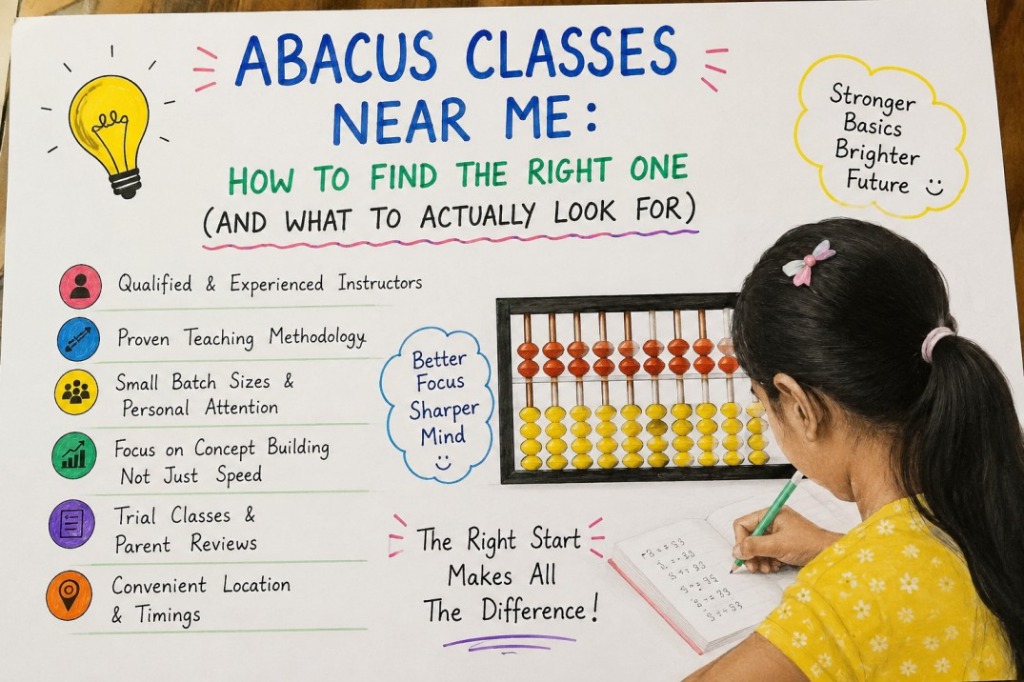
How to Actually Evaluate a Center Near You
Forget the brand name for a second. Here’s what actually matters:
1. Watch a class before enrolling
Any decent center will let you observe a class. If they won’t, that’s your first red flag.
What to look for:
- Is the teacher actually engaging with individual students, or just lecturing at the front?
- Are the kids actively practicing, or sitting idle while the teacher works with one student?
- Is the class size manageable? More than 12-15 kids per teacher and individual attention drops off sharply.
2. Ask about the teacher’s qualifications
Not their degree — their abacus qualifications. A good abacus teacher should be able to:
- Demonstrate calculations on the abacus fluently
- Explain the reasoning behind bead movements (not just “do this”)
- Show you their own certification level
Some centers hire teachers who’ve only completed 3-4 levels of the program themselves. That’s fine for teaching beginners, but it becomes a problem when your child advances past level 4.
3. Check the progression timeline
Ask: “How long does the average student take to complete all levels?”
If they say “2 years” for a 10-level program, they’re either rushing students or being optimistic. Most students take 2.5-3 years. That’s normal and healthy.
If they say “it depends on the child,” that’s actually the best answer. It means they’re not pushing everyone through at the same pace.
4. Ask about homework expectations
Good abacus programs require daily practice at home — typically 10-15 minutes. If the center says “no homework needed,” the results will be slow.
On the flip side, if they’re assigning 30-45 minutes of daily practice to a 6-year-old, that’s too much. The sweet spot for most kids is 10-15 minutes, ideally at a fixed time each day.
5. Talk to parents of current students
The best quality signal is hearing from parents whose kids have been in the program for 6+ months. Don’t just ask “is it good?” — ask specific questions:
- “Has your child’s mental math actually improved?”
- “How does your child feel about going to class?”
- “Were there any issues with the teacher?”
- “Would you enroll a second child?”
That last question is the most revealing. If they hesitate, there’s probably a reason.
Red Flags to Watch For
In my experience, these are warning signs:
❌ “Your child will become a math genius!” — No responsible educator makes guarantees like this. The abacus builds specific skills. It’s not a magic pill.
❌ Pressure to buy expensive kits — A basic soroban costs ₹200-400. If they’re pushing a ₹2,000 “premium kit,” question why.
❌ No progress reports — You should know where your child is in the curriculum, what they’ve mastered, and what they’re struggling with. Monthly or quarterly updates are reasonable.
❌ Teacher changes frequently — High teacher turnover usually means the center doesn’t treat its staff well. That affects teaching quality.
❌ No trial period — Most good programs offer 1-2 free trial classes. If they demand upfront payment before your child has even tried a class, be cautious.
Do You Even Need Classes? The Honest Answer.
Here’s something most abacus programs won’t tell you: a lot of kids can learn the basics at home.
The fundamentals of abacus math — bead values, number representation, simple addition and subtraction — aren’t that complicated. A motivated parent with a good tutorial and a free practice tool can teach the first 2-3 months of material without any classes.
Classes become valuable when:
- Your child needs structure and accountability (someone other than a parent telling them to practice)
- You want access to a progressive curriculum with assessments
- Your child is motivated by competition and wants to participate in tournaments
- You’ve hit the carrying/borrowing concepts and need an expert to explain them properly
Here’s what we’d suggest: try the free route first. Use our online abacus tool, go through the learning path, and practice for 2-3 weeks. If your kid takes to it and you want more structure, then enroll in a local class. You’ll go in knowing the basics, which means the class time is more productive from day one.
Finding Classes Near You
Practically speaking, here’s how to find abacus centers in your area:
- Google Maps: Search “abacus classes near me” — most franchises have Google listings with reviews
- SIP Abacus locator: sipacademyonline.com has a center finder
- UCMAS locator: ucmas.in lists centers by city
- Just Call India / Sulekha: These directories list abacus classes in most Indian cities
- Ask at your kid’s school: Many schools have partnerships with abacus programs or can recommend local centers
For parents outside India: UCMAS and Aloha have international presence. In the US, UK, and Canada, you’ll also find independent Soroban teachers through local community centers and Japanese cultural organizations.
Online Abacus Classes — Are They Any Good?
Post-COVID, most major programs offer online classes. Here’s the reality:
Pros:
- More convenient (no travel time)
- Can choose from a wider pool of teachers
- Usually slightly cheaper
- Recorded sessions for review
Cons:
- Harder for the teacher to see the student’s hand movements and correct technique
- Less engaging for younger kids (5-7) who benefit from in-person interaction
- Easy to get distracted at home
Our take: Online works fine for kids 8+ who are self-motivated. For younger kids, in-person is better if it’s available.
What Happens If You Can’t Find (or Afford) Classes?
You don’t need classes to learn abacus. Really.
We built AbacusTool.xyz specifically for this. It’s a free, interactive abacus that works on any device. We also have:
- Step-by-step tutorials covering everything from basics to carrying and borrowing
- A structured learning path that mimics what classes teach
- Worksheet generator for practice problems
- Flash Anzan for speed training
- Time Attack challenges to make practice more fun
Is it a replacement for a good teacher? No. But it’s a solid free alternative if classes aren’t accessible or affordable for your situation.
The most important thing isn’t whether you use a class, a tool, or a physical abacus. It’s consistent daily practice. 10-15 minutes a day beats a 2-hour weekend class every time.
Written by Devdatta Dhaigude
Creator of AbacusTool.xyz. B.Tech Computer Engineering. 500+ students taught abacus and mental arithmetic.
More about the author →