So you want to learn abacus. Maybe you’re a parent looking to teach your child at home, or maybe you’re an adult who wants to get sharper at mental math. Either way, you don’t want to spend ₹20,000 on classes before you even know if you’ll stick with it.
Good news: you can learn the fundamentals at home, for free, and get genuinely good at it. The catch? You need to actually practice. Daily. 10-15 minutes is enough, but those minutes need to happen consistently.
Here’s a realistic roadmap. No fluff, no “you’ll be a genius in 30 days” nonsense.
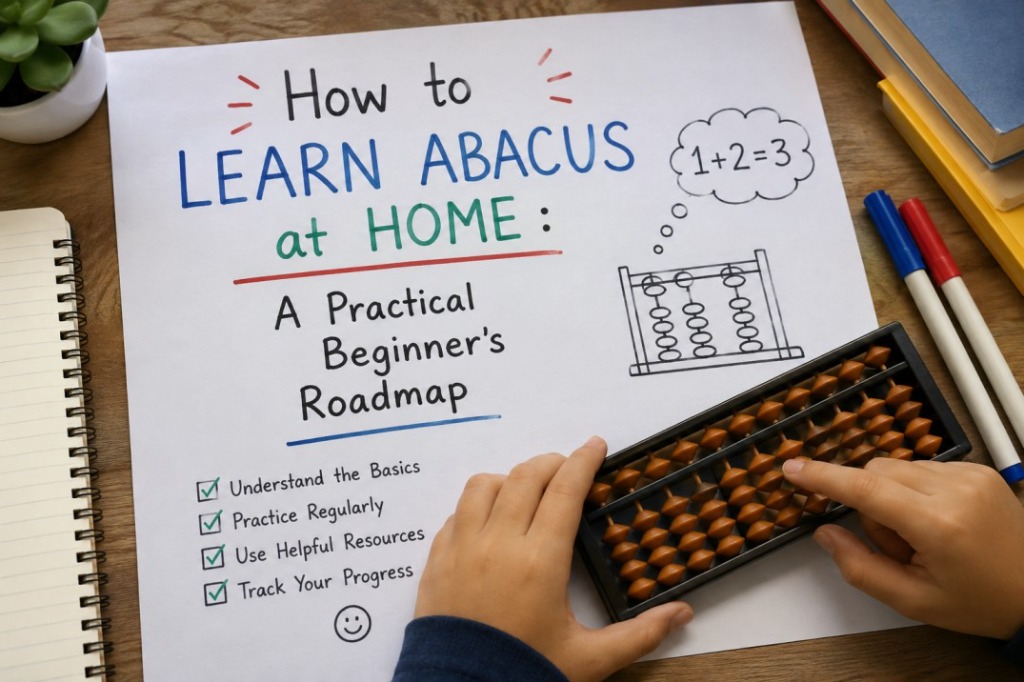
Before You Start: What You’ll Need
The only tool you need: An abacus. Either a physical one (₹200-400 on Amazon for a basic 13-rod soroban) or our free online abacus. Both work fine. The digital version is actually easier to start with because it shows you the current value, so you can verify your work immediately.
What you don’t need:
- Expensive kits
- Workbooks (we’ll give you free alternatives)
- A tutor (at least not for the first few months)
- Any prior math knowledge beyond basic counting
Week 1: Learn the Basics (Days 1-7)
Day 1-2: Understand the structure
Open our beginner’s guide alongside the abacus tool and learn these three things:
The layout:
- Each rod represents a place value (ones, tens, hundreds…)
- The bar in the middle divides “heaven beads” (top) from “earth beads” (bottom)
Bead values:
- Heaven bead (top) = 5 when pushed down toward the bar
- Each earth bead (bottom) = 1 when pushed up toward the bar
- Beads away from the bar = 0 (not activated)
How to “enter” a number:
- Start from the rightmost rod (ones place)
- Push beads toward the bar to activate them
Try this now: represent the number 7 on the ones rod.
Answer: Push the heaven bead down (that’s 5) + push 2 earth beads up (that’s 2) = 7. ✓
Day 3-4: Practice numbers 0-9 on a single rod
This is the foundation. You need to represent every single digit without thinking. Practice until it’s automatic.
| Number | Heaven bead | Earth beads |
|---|---|---|
| 0 | Up | All down |
| 1 | Up | 1 up |
| 2 | Up | 2 up |
| 3 | Up | 3 up |
| 4 | Up | 4 up |
| 5 | Down | All down |
| 6 | Down | 1 up |
| 7 | Down | 2 up |
| 8 | Down | 3 up |
| 9 | Down | 4 up |
Drill: Have someone call out random single digits. Represent each one as fast as you can. Do this for 5-10 minutes.
Day 5-7: Two-digit and three-digit numbers
Now use multiple rods. The second rod from the right is tens, the third is hundreds.
Practice these:
- 42 → Tens rod: 4 earth beads up. Ones rod: 2 earth beads up.
- 85 → Tens rod: heaven bead down + 3 earth beads up. Ones rod: heaven bead down.
- 137 → Hundreds: 1 earth bead up. Tens: 3 earth beads up. Ones: heaven bead down + 2 earth beads up.
By the end of week 1, you should be able to represent any 3-digit number in under 5 seconds. If you’re not there yet, spend another day or two on this. There’s no rush.
Week 2: Simple Addition (Days 8-14)
The basic rule
To add, you just push more beads toward the bar. If you have 3 on the ones rod (3 earth beads up) and want to add 2, you push 2 more earth beads up. Now you have 5 — wait, but that means all 4 earth beads are up plus you need one more.
This is where it gets interesting.
When earth beads aren’t enough: Use the heaven bead
When you need to add but there aren’t enough earth beads, you use the “friend of 5” method:
To add 4 (but only 1-3 earth beads are left): Push the heaven bead down (add 5), then pull back 1 earth bead (subtract 1). Net effect: +4.
To add 3 (but only 0-2 earth beads are left): Push heaven bead down (add 5), pull back 2 earth beads (subtract 2). Net effect: +3.
To add 2 (but only 0-1 earth beads are left): Push heaven bead down (add 5), pull back 3 earth beads (subtract 3). Net effect: +2.
To add 1 (but 0 earth beads are left): Push heaven bead down (add 5), pull back 4 earth beads (subtract 4). Net effect: +1.
This is the “complement of 5” concept. It sounds confusing when you read it, but it makes perfect sense when you do it with beads in front of you.
Practice problems for Week 2
Start with these — all single rod, no carrying to the next column:
- 2 + 3 = ?
- 1 + 4 = ?
- 3 + 5 = ?
- 6 + 2 = ?
- 4 + 4 = ?
Then try: 6. 1 + 3 + 2 = ? 7. 5 + 2 + 1 = ? 8. 2 + 2 + 4 = ?
If you can do these consistently on the abacus and get the right answer, you’re on track.
Week 3: Carrying (The “Friends of 10”) (Days 15-21)
This is where most beginners hit a wall. Carrying is the hardest concept to learn, and it’s also the most important.
When it happens
Carrying happens when a rod exceeds 9. For example: you have 8 on the ones rod and you add 5. The answer is 13 — you can’t show 13 on a single rod (max is 9). So you need to:
- Add 1 to the tens rod
- Subtract the complement from the ones rod
The “friends of 10”
These are complement pairs that add up to 10:
| Number | Friend of 10 |
|---|---|
| 1 | 9 |
| 2 | 8 |
| 3 | 7 |
| 4 | 6 |
| 5 | 5 |
| 6 | 4 |
| 7 | 3 |
| 8 | 2 |
| 9 | 1 |
Memorize these. Seriously. They need to be instant. When you see “7,” your brain should automatically think “3.” Use our complement drills tool to practice until it’s reflex.
How carrying works in practice
Example: 8 + 5
- Set 8 on the ones rod (heaven bead down + 3 earth beads up)
- You want to add 5, but there’s not enough room on this rod
- The friend of 5 is 5 (10 - 5 = 5)
- So: add 1 to the tens rod, then subtract 5 from the ones rod
- Tens rod: 1 earth bead up. Ones rod: clear the heaven bead (remove 5), keep 3 earth beads.
- Result: tens = 1, ones = 3 → 13 ✓
It’s the same logic as paper math carrying, just expressed through bead movements.
Practice problems for Week 3
- 7 + 4 = ?
- 9 + 3 = ?
- 6 + 8 = ?
- 8 + 7 = ?
- 15 + 7 = ?
- 23 + 9 = ?
- 45 + 38 = ?
If you can do #7 on the abacus, you’ve got carrying down.
Week 4: Subtraction and Borrowing (Days 22-28)
Subtraction is the reverse of addition, and borrowing is the reverse of carrying.
Basic subtraction
To subtract, pull beads away from the bar. If you have 7 (heaven + 2 earth beads up) and subtract 3, pull 3 earth beads down. Now you have 4. Simple.
When you can’t subtract directly
If you have 2 on the ones rod and want to subtract 5, you don’t have enough beads to remove. That’s when you borrow.
How borrowing works
Example: 12 - 5
- You have 12 (tens rod: 1 earth bead up, ones rod: 2 earth beads up)
- You want to subtract 5 from the ones rod, but only 2 are there
- Borrow from tens: subtract 1 from tens rod (now tens = 0)
- Add the friend of 5 (which is 5) to the ones rod: push heaven bead down
- Wait — but we also need to account for the 5 we subtracted. We borrowed 10 and subtracted 5, so we added 5 net.
- Actually, let me redo this more clearly.
Let me give you the clean rule:
To subtract N when there aren’t enough beads: Subtract 1 from the next rod (borrow 10), then add (10 - N) to the current rod.
Example: 12 - 5
- Set 12. Tens: 1, Ones: 2.
- Subtract 5 from ones. Not enough beads.
- Subtract 1 from tens (tens becomes 0 — you’ve borrowed 10).
- Add (10 - 5) = 5 to ones. Ones was 2, now 2 + 5 = 7.
- Result: 07 → 7 ✓
Practice problems for Week 4
- 9 - 3 = ?
- 8 - 5 = ?
- 15 - 7 = ?
- 23 - 8 = ?
- 42 - 17 = ?
- 100 - 36 = ?
Month 2: Speed and Consistency
By now you know the four operations: simple addition, addition with carrying, simple subtraction, subtraction with borrowing. That covers about 80% of practical abacus use.
Month 2 is about making it fast and automatic.
Daily routine (15 minutes)
- Warm-up (3 min): Represent 10 random 3-digit numbers on the abacus as fast as you can
- Drills (7 min): Do 15-20 addition/subtraction problems. Mix them up. Use our worksheet generator or time attack
- Challenge (5 min): Try one multi-step problem like 23 + 47 - 15 + 38
Track your speed
Time yourself doing 10 simple additions (like 34 + 27). Record the time. Repeat every few days. You should see clear improvement:
- Week 1 of practice: probably 3-5 minutes for 10 problems
- Week 4: under 2 minutes
- Month 3: under 1 minute
If you’re not improving, you probably need more work on complements (friends of 5 and 10). Go back to the complement drills.
Month 3-4: The Mental Abacus Transition
Once you can do calculations on the physical (or digital) abacus quickly and accurately, it’s time to start building the mental abacus.
This is the payoff. This is what makes all the practice worth it.
How to start
- Do a problem on the abacus. Say, 25 + 13.
- Close your eyes and imagine the beads. Picture the starting position (25), then visualize adding 13.
- Check your mental answer against the physical abacus.
At first, you’ll lose the image. The beads will blur in your mind, or you’ll forget which rod you were on. That’s completely normal. It takes most people 2-4 weeks of daily mental practice to hold a stable image.
Tips for building the mental abacus
- Start with 2-digit numbers. Don’t jump to 3+ digits until 2-digit mental math is easy.
- Practice in quiet places. Noise makes it harder to maintain the mental image.
- Some people find it helps to move their fingers slightly, mimicking bead movements. That’s fine — even competition-level players do this.
- If you’re a visual person, the transition will be faster. If you’re more of an auditory learner, it might take longer. Both is okay.
Is Abacus Good for Kids? Our Experience.
After teaching 500+ students, here’s what I can say with confidence:
Ages 5-7: Kids pick up bead movements quickly. They learn the physical part faster than adults. But the mental abacus transition is harder at this age — their visualization skills are still developing. Focus on making it fun. Don’t push speed too hard.
Ages 8-12: The sweet spot. Old enough to understand the logic, young enough that the mental abacus develops naturally. Most kids who start in this range can develop solid mental math skills within 12-18 months of consistent practice.
Ages 13+: Still works, but the learning curve is steeper. Teenagers and adults tend to overthink the bead movements instead of letting muscle memory develop. The mental abacus also takes longer to build. But the results are still real.
What abacus does NOT do:
- It doesn’t make kids “math geniuses”
- It doesn’t replace understanding mathematical concepts
- It doesn’t work without regular practice (nothing does)
What it DOES do:
- Builds strong number sense
- Makes mental arithmetic faster and more accurate
- Improves concentration and working memory
- Gives kids confidence in math (this one is underrated)
Common Mistakes Beginners Make
Avoid these, and you’ll progress faster:
1. Skipping complement practice
Complements are the foundation. If you can’t instantly recall that the friend of 7 is 3, carrying will always feel slow and unnatural. Drill them until they’re automatic.
2. Moving to mental abacus too early
You need the physical movements to be completely automatic before you try going mental. If you’re still thinking about which beads to move, your mental abacus attempts will fail. Build the physical speed first.
3. Practicing once a week for an hour instead of daily for 10 minutes
Frequency beats duration. Your brain builds the neural pathways through repetition, and those pathways strengthen faster with daily short sessions than with weekly long ones. This is backed by spaced repetition research.
4. Not verifying answers
Always check. On the digital abacus, the value display shows you immediately whether you’re right. On a physical abacus, read the result and verify with a calculator. Practicing wrong technique is worse than not practicing at all.
5. Giving up at Week 3
The carrying concept is the first real challenge. Almost everyone struggles with it. Push through. Once carrying clicks (and it will), everything after it feels easier by comparison.
Your Free Toolkit
Everything you need is on this site, completely free:
- Abacus Tool — Interactive soroban that works on any device
- How to Use Guide — Visual step-by-step tutorial
- Learning Path — Structured curriculum from beginner to advanced
- Complement Drills — Practice friends of 5 and 10
- Worksheet Generator — Unlimited practice problems
- Time Attack — Timed speed challenges
- Flash Anzan — Rapid mental calculation training
- Step Solver — See how calculations are done step by step
No signup. No email required. Just open any tool and start.
The abacus has been around for 4,000+ years because it works. The only variable is whether you’ll put in the daily 10-15 minutes. If you do, you’ll see results. I’ve watched it happen with hundreds of students, and it’s pretty satisfying every single time.
Written by Devdatta Dhaigude
Creator of AbacusTool.xyz. B.Tech Computer Engineering. 500+ students taught abacus and mental arithmetic.
More about the author →